Cloud gaming has undoubtedly reshaped how we think about playing games, but it comes with legitimate questions and concerns from the gaming community. Over the past few years, I've seen the same criticisms come up repeatedly in forums, social media, and conversations with players. Rather than dismissing them, I think they deserve thoughtful responses grounded in real-world experience and technical context. Let me work through each one.
1. Is latency and input lag still a problem for cloud gaming?
This is the objection you hear most often, and I understand why. The fear of sluggish controls or delayed input is a valid starting point, especially for competitive shooters and fighting games where every millisecond matters.
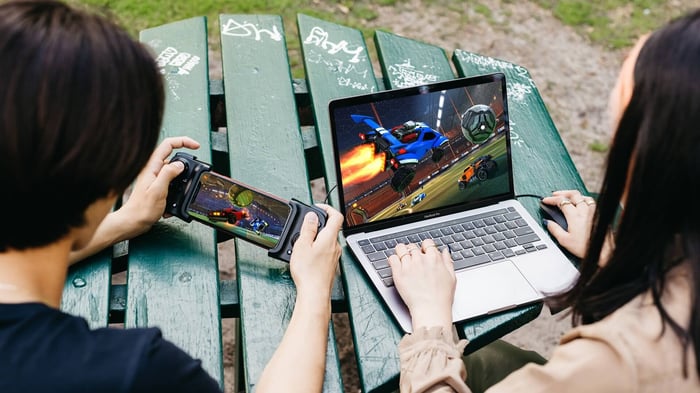
Here's what we're seeing in practice, though: for the vast majority of players meeting the internet requirements, latency is simply imperceptible during gameplay. This has even been demonstrated in blind testing, where gamers have been playing via the cloud without realising, and report no issues with input lag. In addition, some of the most popular games on GeForce NOW are in fact competitive titles like Fortnite, Marvel Rivals, Apex Legends and Battlefield 6.
That said, this criticism isn't baseless, and I don't want to dismiss the real negative experiences gamers have had, just place them in their proper context. Players with unreliable connections, poorly configured home networks, or who live far from the nearest cloud server can absolutely experience noticeable input lag. These scenarios are real, and they do limit cloud gaming's suitability for those particular users.
The good news? Even for those gamers with sub-optimal connections, there is plenty of value to be found in the cloud. Turn-based games, story-driven adventures, strategy and puzzle games all play wonderfully over cloud regardless of a few extra milliseconds. If you fall into that lower-lag-tolerance category, you've still got a massive library of excellent cloud-friendly titles to explore.
2. Can cloud gaming really deliver consistent, high quality visuals?
Streaming quality can vary significantly depending on your cloud provider and subscription tier. I won't pretend all services are equal here. GeForce NOW stands out in the market by adopting cutting-edge technologies like AV1 compression, AI sharpening filters, NVIDIA Reflex, and L4S (Low Latency, Low Loss, Scalable throughput). The result is visual fidelity that genuinely impresses, even for discerning players.
It's also worth considering the comparison that matters most to individual gamers. Yes, you might notice subtle compression artefacts or occasional softness in foliage in visually complex scenes. But most players are upgrading to the cloud from older gaming PCs and any occasional streaming artefacts are more than made up for by stunning 4K visuals at the higest in-game settings. And for those playing on phones, tablets, or other devices where local gaming simply isn't an option, the question of "is it as good as my old rig" becomes irrelevant. It's the gateway that enables them to play at all.
Streaming technology continues to improve rapidly. The encoding standards we're using today are light years ahead of where they were five years ago, and the trajectory points toward even better quality going forward.
3. Isn't cloud gaming too dependent on having strong, stable internet?
This criticism mirrors the latency concern, and the answer follows a similar logic. Yes, cloud gaming requires quality internet. Unlike a gaming console with a fairly universal experience, the quality of your connection directly affects yours.
But here's the counterpoint: internet infrastructure is continually improving on a global scale. Australia, which historically struggled with connectivity, has seen massive gains through Fibre to the Premises rollouts. Most households now have access to genuinely solid broadband, and that trend will only continue.
More immediately, you don't have to be passive. A small investment in your home network pays dividends. A WiFi 6 or WiFi 7 router, or even just running Ethernet where feasible, creates a dramatically more stable environment. These upgrades benefit not just cloud gaming, but every connected device in your home. Better video calls, faster downloads, smoother streaming. It's a win across the board.
4. Is cloud gaming bad for game ownership, leading to an "own nothing and be happy" future?
This criticism often stems from misunderstanding how different cloud services actually work, with assumptions drawn that they operate on a Netflix style included library model, or a native digital storefront like Google Stadia did.
GeForce NOW operates on a fundamentally different model. You don't buy games from GeForce NOW. You buy them from Steam, Epic Games Store, Ubisoft+, and other platforms you already use and trust. GeForce NOW simply connects to your existing libraries and lets you play them on our servers. You own those games in exactly the same way you own them on your PC. That distinction matters enormously.
This is fundamentally different from the "rent-your-games" model some gamers fear. You're purchasing ownership through established storefronts and gaining flexibility in how you play those games.
5. Do cloud gaming providers want to force all gamers into the cloud?
You'll hear both advocates and critics speak of cloud gaming as "the future," and the negative interpretation is that providers like NVIDIA, Sony, and Microsoft want to eliminate local hardware entirely and force everyone into cloud gaming ecosystems.
I think that speculation underestimates the complexity and cost involved. Let me be direct: I don't believe we'll see a future where cloud gaming entirely replaces local hardware, and more importantly, I don't think the major providers are pushing for that to happen.
The infrastructure investment required to provide adequate cloud gaming coverage to a global majority is staggering. The technical complexity, support burden, and reliance on third-party ISPs and consumer home networks creates enormous operational risk. These companies are savvy enough to recognise that putting all their eggs in this basket introduces as many problems as it solves.
What makes far more sense is a complementary model: cloud gaming as a powerful pillar of the gaming ecosystem, sitting alongside thriving local hardware gaming. Players choose the option that fits their needs, device, and preferences. Some sessions happen locally. Others happen in the cloud. The infrastructure, innovation, and choice expand for everyone.
Where can I try cloud gaming for free?
If you're curious about how all of this feels in practice, the best thing you can do is try it yourself. Cloud gaming is one of those experiences that is hard to judge from screenshots or specs alone, and much easier to understand once you have a controller or mouse in hand.
You can jump in with a free 3‑hour Ultimate Trial and put it to the test on your own connection, with your own games and your own setup. Try a few different genres, and see how the latency, visual quality, and overall feel stack up to your expectations. There is no better way to cut through the noise than by experiencing it first-hand.